With the advancement of industrial modernization and the upgrading of domestic water demand, PPH pipes have become a core choice for pipelines in various fields due to their excellent corrosion and impact resistance. Statistics show that the market scale of China's PPH products reached 32 billion yuan in 2025 and is expected to exceed 50 billion yuan in 2026. However, the industry is currently plagued by common pain points such as uneven quality and inadequate scenario adaptation. Jiangsu Jiqing Group, a veteran enterprise with 17 years of experience in the anti-corrosion pipeline and fitting industry, has accurately addressed these industrial pain points. Through stringent quality control and technological innovation, the Group has developed
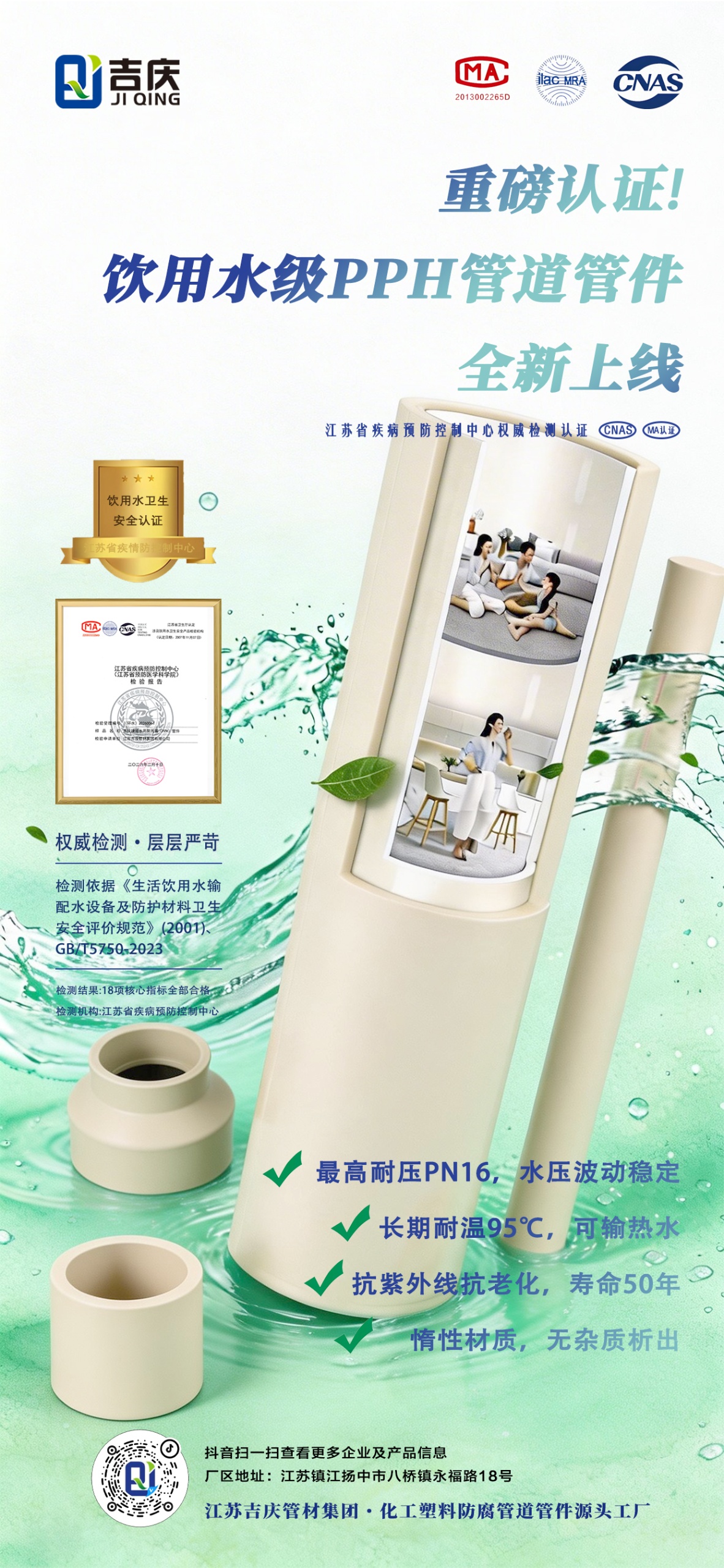
PPH pipes and fittings that combine industrial-grade performance with civil-grade safety, and successfully obtained authoritative testing and certification from the Jiangsu Center for Disease Control and Prevention in February 2026.
Jiqing Group's PPH pipes and fittings have passed testing and certification with all 18 core sanitary indicators up to standard. The tests cover basic indicators such as chromaticity and turbidity, heavy metal indicators including arsenic and lead, as well as harmful organic compound indicators like trichloromethane. All results strictly comply with the requirements of the Hygienic Safety Evaluation Specification for Drinking Water Distribution and Transmission Equipment and Protective Materials (2001), eliminating potential safety hazards from the source and enabling the pipes to be safely used in drinking water transmission and laboratory reagent delivery scenarios.
Authoritative Testing and Certification: 18 Indicators Lay a Solid Foundation for Safety
The Jiangsu Center for Disease Control and Prevention conducted comprehensive tests on Jiqing's PPH pipes and fittings, including chromaticity, turbidity, odor and taste, visible matter, pH value, total dissolved solids, permanganate index (calculated as O₂), heavy metal indicators (arsenic, cadmium, hexavalent chromium, aluminum, lead, mercury, etc.), and harmful organic compound indicators (trichloromethane, volatile phenols, barium, antimony, carbon tetrachloride, tin, etc.). All test results met the relevant standards. Adhering to the principle of eliminating safety hazards from the source, Jiqing Group ensures that its PPH pipes and fittings can be safely applied in domestic drinking water transmission and laboratory reagent delivery scenarios.
From the test results, in terms of appearance and physical indicators, the chromaticity of Jiqing's PPH pipes is less than 5 degrees, far lower than the hygienic specification requirement of "≤5 degrees". The standard turbidity is 0.23 NTU, and Jiqing's PPH products also reach 0.23 NTU, fully meeting the specification's requirement of "≤0.2 NTU". All products have no peculiar smell, abnormal odor, or any visible debris and impurities after immersion. In terms of chemical and toxicological indicators, the standard pH value is 7.79, and Jiqing's PPH products register at 7.80, complying with the hygienic standard that the variation range shall be less than 0.5. Test results for heavy metals, harmful substances, organic pollutants and other items all meet the specification requirements, making the products qualified with authoritative certification and suitable for scenarios with high safety demands.
Breaking Scenario Limitations: Realizing Dual Adaptation for Industrial and Civil Use
As we all know, PPH pipes are traditionally widely used in industrial fields thanks to their excellent corrosion and impact resistance, especially in chemical plants, electroplating plants and other industrial scenarios. They are mainly used to transport various corrosive chemical solutions, chemical production wastewater and industrial circulating water, and have become the preferred pipes for industrial pipeline systems due to their stable performance. On the basis of fully meeting the stringent working condition requirements of chemical water treatment pipelines, Jiqing Group's PPH pipes and fittings have broken the traditional application limitations of PPH pipes. Relying on a sanitary control system far exceeding industry standards, the Group has successfully expanded the application scenarios to domestic water pipelines, scientific research laboratories, pharmaceutical and other fields with extremely high water quality safety requirements, truly achieving a dual breakthrough of "industrial-grade quality and civil-grade safety" and balancing performance and safety.
Civil Scenarios: Unaffected by Regional Conditions, Eliminating Freeze Crack Risks
At present, ordinary plastic pipes such as PP, PPR and PVC are still the main choice for indoor and outdoor water pipelines in most households and civil buildings. Although these pipes can meet basic water demand, they have obvious performance shortcomings. Compared with these ordinary plastic pipes, Jiqing's PPH pipes have prominent advantages, especially suitable for complex service environments. This is particularly evident in cold northern regions with huge day and night temperature differences, where the outdoor temperature can drop below -20℃ on winter nights. Ordinary PP pipes have a temperature resistance range of -10℃~60℃, PPR pipes 20℃~95℃, and PVC pipes only 0℃~45℃. In extremely low temperature environments, these ordinary pipes are prone to freeze cracking, embrittlement, joint falling off and other problems, which seriously affect the normal water supply of pipelines and even cause water leakage hazards. Therefore, Jiqing Group's PPH pipes have greater advantages in drinking water transmission.
Pharmaceutical Field: High Purity Adaptation with Cost-Effective Advantages
In the pharmaceutical field, pipelines are usually used to transport chemical raw materials, water for injection, or treat waste gas and wastewater, imposing higher requirements on the pipes. As time goes by, ordinary industrial-grade PPH products will leach harmful substances when eroded by chemical reagents. To avoid this, many manufacturers choose
PVDF pipes with higher rigidity and safety, but PVDF products cost much more than PPH products. Jiqing Group's PPH pipes, however, can meet the above requirements—they will not leach metal ions when transporting organic solvents, purified water, water for injection, etc., thus ensuring the purity of pharmaceutical products.
Adhering to the Original Aspiration, Strictly Controlling Quality, and Forging Excellent Product Performance
The outstanding performance of Jiqing's PPH pipes is inseparable from the Group's stringent quality control. Relying on new national standard raw materials and advanced production processes, Jiqing Group's PPH pipes undergo dozens of strict quality control procedures, completely solving many pain points of ordinary plastic pipes:
The pipes feature high purity with no impurity leaching during long-term use, strictly complying with the hygienic requirements for drinking water distribution and transmission, making them safer and more reliable for daily household water use and laboratory precision reagent delivery.
With excellent pressure resistance, the pipes can bear a maximum pressure of PN16, suitable for different pressure scenarios. They also have stable long-term temperature resistance up to 95℃, enabling direct hot water transmission and perfectly meeting the needs of household hot water pipelines and laboratory constant temperature fluid delivery. Meanwhile, the pipes boast excellent UV and aging resistance, not easy to age or embrittle for outdoor use, with a service life of up to 50 years—far exceeding that of ordinary plastic pipes. This greatly reduces the labor and material costs of later pipeline replacement and maintenance. Whether for industrial production, civil water supply or laboratory research scenarios, Jiqing Group's PPH pipes and fittings are the more cost-effective preferred pipelines.